Research
My work covers three stages of a building's life: production of precast modules, inspection on site, and maintenance in operation. In each stage, an AI model produces an output and a separate check decides whether the output can be used. The check can train the model, stop an output before release, compare the model with established rules on a benchmark, or send the output to an engineer.
Research framework

AI perception for construction quality inspection
Ph.D. research, NTU, 2022–2026
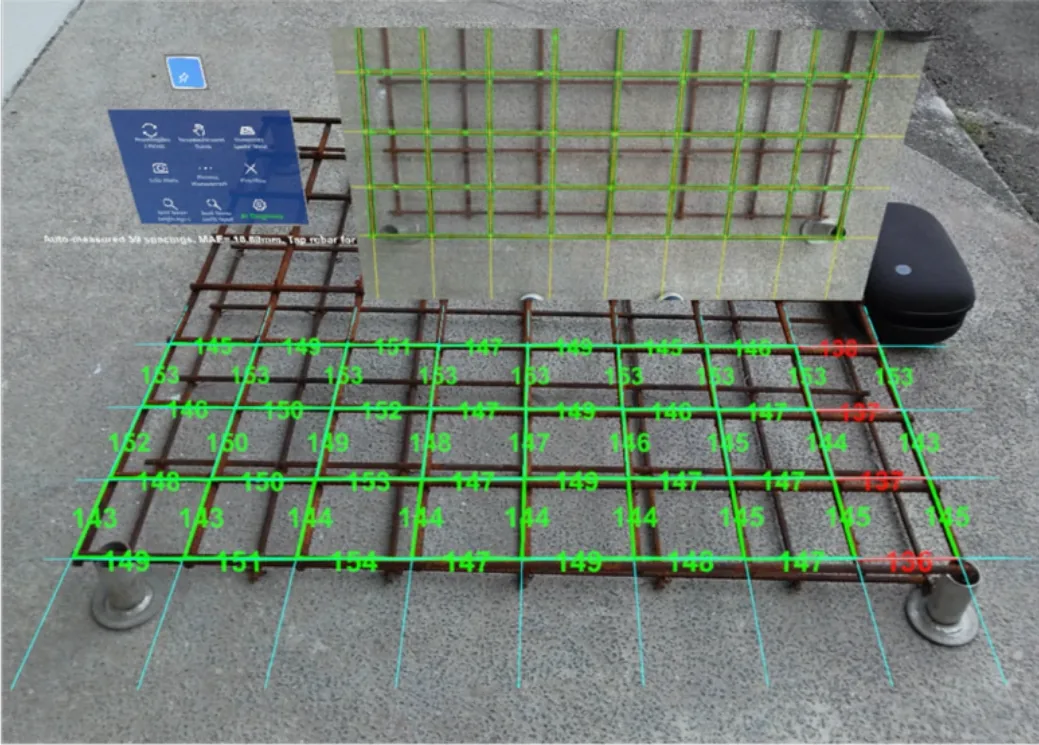
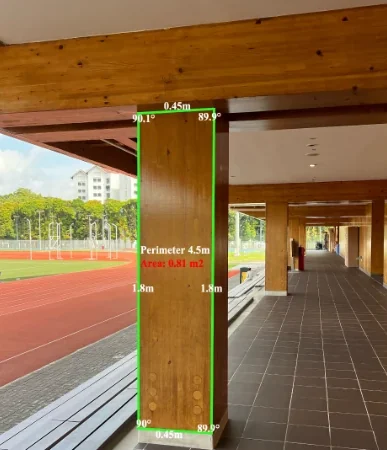
I built mixed reality systems that measure building elements and rebar cages with vision foundation models and show pass or fail results to the inspecting engineer on site. The engineer checks each result against the tolerance before accepting it. ARMIS, the rebar spacing system, was validated in live inspection with Expand Construction on the NS Square project at The Float @ Marina Bay.
Evidence
- ARMIS was validated in live rebar inspection with Expand Construction Pte Ltd, main contractor for the NS Square project at The Float @ Marina Bay.
- Related systems measure timber components from the inspector's gaze, and large building elements in day and night conditions.
- Four papers are published or accepted, and the ARMIS paper is under minor revision.
How it works
- HoloLens 2 viewThe headset captures the rebar cage or building element in view.
- Find the barsRebarSAM finds each bar, and monocular depth separates the layers.
- Check: Tolerance checkEach measured spacing is compared with the specified tolerance.
- Pass or fail hologramResults appear on the cage, and the engineer confirms them.
Papers
- [1]PublishedIntegrating Mixed Reality with Key Digital Technologies for Elevating On-site Construction Efficiency: An Integrative Review and Framework
- [2]PublishedAutomated Noncontact Geometric Quality Assessment of Building Elements Integrating Mixed Reality, Depth Sensing, and Vision Foundation Model
- [3]PublishedGaze-Driven Mixed Reality for Dimensional Quality Assessment of Timber Components Using a Few-Shot RGB-D Vision Foundation Model
- [4]PublishedHuman-in-the-Loop Rebar Inspection: Integrating Vision Foundation Model with Mixed Reality for Construction Quality Assurance
- [5]Minor revisionAutomated Rebar Spacing Measurement in Mixed Reality Using RebarSAM and Monocular Depth Estimation
Scheduling and dispatching decisions
SIT, 2026–present
In precast (PPVC) module factories, I develop deep reinforcement learning and graph neural network methods that respect time lags, machine setups and availability windows, and that use optimality bounds during training. In facility management, I build open benchmarks from maintenance work-order records that show when learned dispatching policies outperform classical priority rules, and methods that learn from supervisor overrides.
Evidence
- Schedules respect time lags between operations, machine setups, availability windows and shared transport.
- Open benchmarks built from maintenance work-order records, with a decision map that shows, by crew utilization, when learned dispatching outperforms priority rules.
- I am developing a human-in-the-loop method that recovers hidden work-order urgency from supervisor overrides.

How it works
- Factory or work ordersOperations in a PPVC module factory, or maintenance work orders.
- Learned policyGraph neural networks and deep reinforcement learning choose the next action.
- Check: Bounds and benchmarksOptimality bounds shape the reward, and benchmarks compare the policy with priority rules.
- Schedule or dispatchA production schedule, or a dispatch plan for maintenance crews.
Papers
- [6]Under reviewTime-Lag-Aware Deep Reinforcement Learning for Flexible Job-Shop Scheduling in PPVC Module Factories
- [7]Under reviewLearning to Schedule in Construction and Built-Environment Operations: A Systematic Critical Review of Deep Reinforcement Learning, Graph Neural Networks, and Multi-Agent Approaches
- [8]Major revisionFM-CrossTraining: Computational Framework and Open Benchmark for Multiskill Maintenance Dispatching
- [9]Major revisionWhich Assets Deserve Attention First? Metric Choice and Budget Risk in Maintenance Prioritization from Infrastructure Work-Order Records
- [10]Under reviewAn Open CMMS-Derived Benchmark for Building-Maintenance Work-Order Dispatching with a Decision Map Keyed on Crew Utilization
- [12]In preparationPACT: Policy Across Composable Timing Rules with a Certified Reward for Flexible Job-Shop Scheduling
- [13]In preparationBOLT: Multi-Bottleneck Bound-Guided Learning for Flexible Job-Shop Scheduling with Time Lags and Resource-Coupled Transport
- [14]In preparationSURGE: A Human-in-the-Loop Framework That Recovers Hidden Urgency from Supervisor Overrides and Applies It to Every Maintenance Dispatch
Language models with verification
SIT, 2026–present
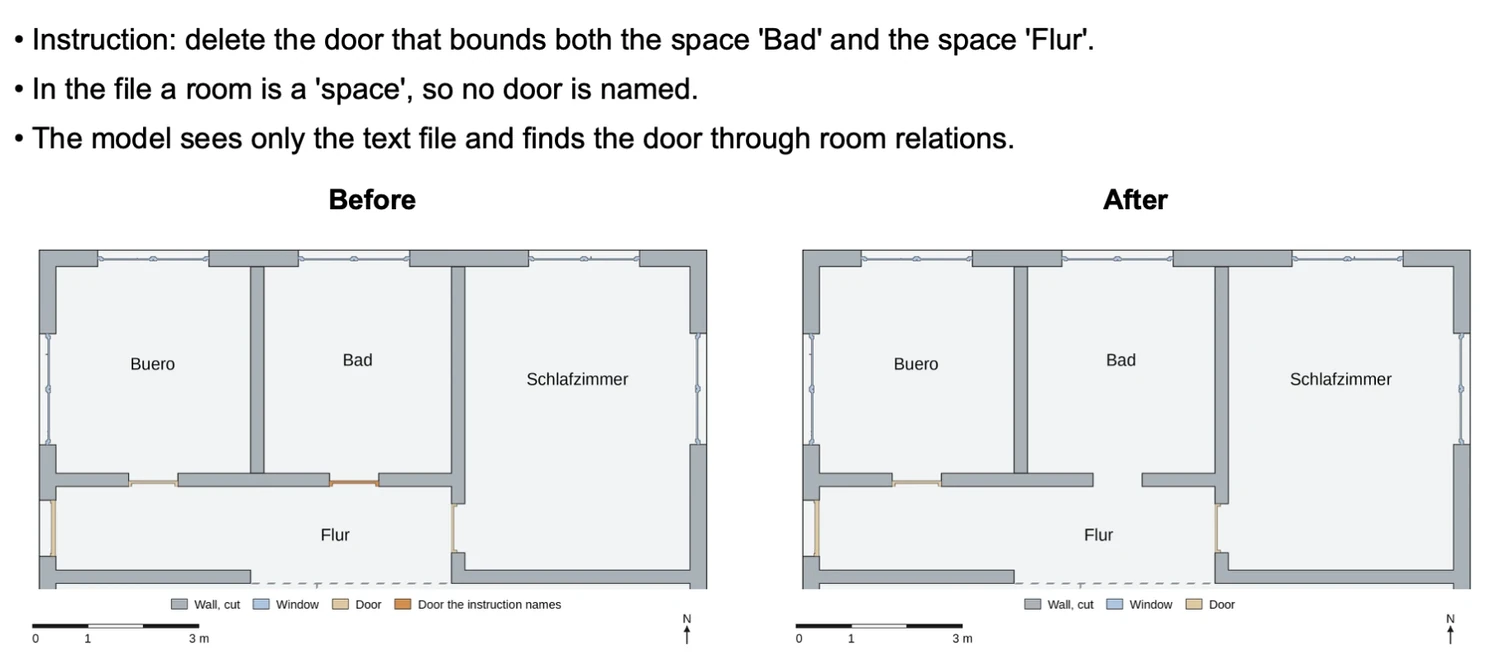
CertiGATE checks each work-order schedule produced by a large language model agent with a quality certificate before release. VeriBIM trains a locally deployable language model to edit IFC building models from natural-language instructions, using an IFC verifier to filter training data, label preference pairs and provide the reinforcement learning reward.
Evidence
- CertiGATE: a guard benchmark and a quality-certificate protocol for language model schedules in facility management.
- VeriBIM: the IFC verifier scores geometry, semantics and topology. It filters training data, labels preference pairs and gives the reinforcement learning reward.
How it works
- Instruction or work orderA natural-language instruction, or maintenance work orders to schedule.
- Language modelA language model agent proposes an IFC edit or a schedule.
- Check: Verifier or certificateAn IFC verifier scores the edit, or a quality certificate checks the schedule.
- Release or retrainChecked outputs are released, and verifier scores train the model.
Papers
Looking ahead, I would like to explore how a digital twin could connect the three stages.